Learning Center

Fragrance Oils FAQ

The fragrance oil questions makers ask us most, answered: how much oil each wax holds, what double and triple scenting mean, what the specs on a product page tell you, and the practical details of storing, mixing, and labeling.

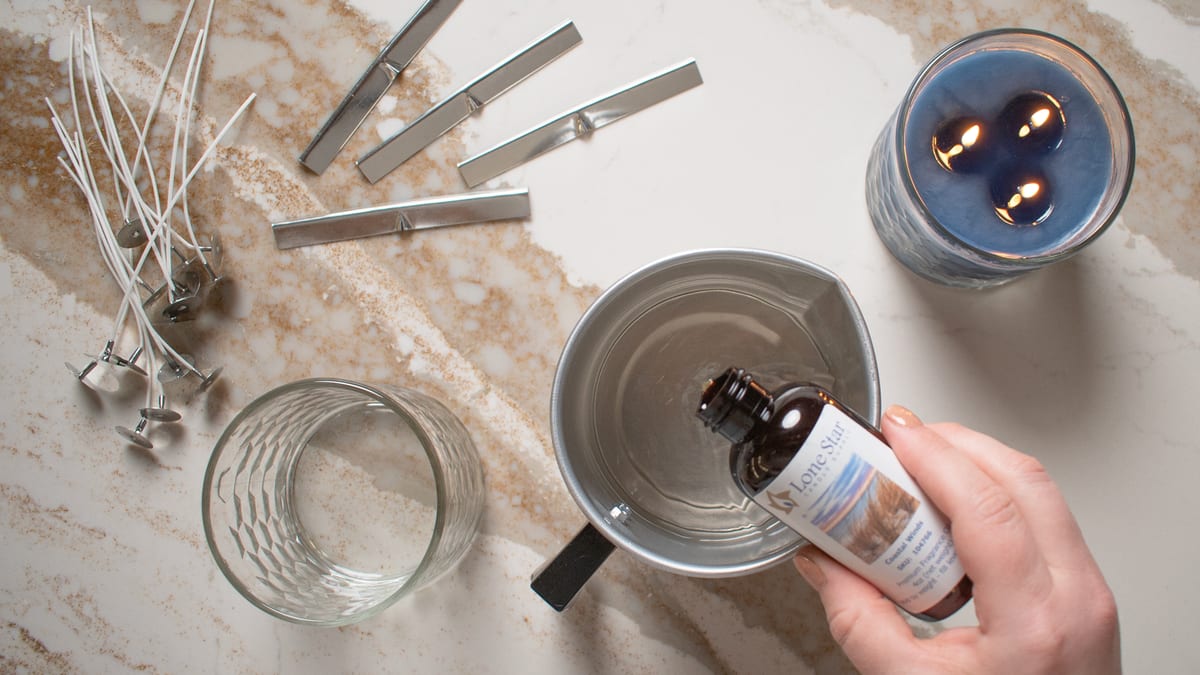
A hand pouring a bottle of Lone Star fragrance oil into a metal pouring pot, beside candle wicks, an empty glass jar, and a finished blue candle

We have been answering fragrance oil questions from makers since 1999, and the same ones come up again and again. This page collects them. The first question, how much fragrance oil to use, deserves more than a one-line answer, so it gets its own section below with the maximum fragrance loads recommended for every wax we carry. The rest are in the FAQ list further down, from shelf life and bottle quirks to gel, soap, and labeling. Every spec discussed here is listed on the product page of each of our fragrance oils.

How Much Fragrance Oil to Use

Start at 1 ounce of fragrance oil per pound of wax, which is about 6% by weight. The industry baseline for a lightly scented candle is half an ounce per pound; most container waxes comfortably hold double that, and several hold more. You can load up to your wax's tested maximum, but never beyond it. Wax can retain only a certain amount of fragrance oil, and any excess may separate from the wax rather than contribute to scent throw.

The maximum varies more by wax than makers expect, from 3% in a base paraffin to 11% in an enhanced soy blend. These are the manufacturer-recommended maximum fragrance loads for the waxes we carry:

Maximum Fragrance Load by Wax

WaxMax loadPer pound of wax
Golden Brands 444 soy (container)9-11%1.44-1.76 oz
Golden Brands 415 soy (container)8-10%1.28-1.6 oz
IGI 4633 container paraffin (J-223)8-10%1.28-1.6 oz
Golden Brands 464 soy (container)7-9%1.12-1.44 oz
Golden Brands 402 soy (container)6-8%0.96-1.28 oz
Golden Brands 454 coconut soy (container)5-10%0.8-1.6 oz
IGI 4627 / 4630 / 4636 / 4786 container paraffins6-10%0.96-1.6 oz
NatureWax C-3 soy (container)6%~1 oz
IGI 4625 pillar / 4761 and 4794 votive blends6%~1 oz
Golden Brands 494 melt and tart wax5-10%0.8-1.6 oz
IGI 4826 tart and chip wax6-8%0.96-1.28 oz
IGI 1230 / 2281 base paraffins3-4%0.48-0.64 oz

Base paraffins can hold more fragrance with an additive such as Vybar 103 or Vybar 260. Each wax's product page carries its own load spec, our candle waxes & additives guide compares the waxes side by side, and our Fragrance Oil Calculators turn a percentage into ounces for any batch size. To see the process done step by step, watch Measuring & Adding Fragrance Oil to Your Wax.

For soap and other personal care products, fragrance usage depends on both the application and the formulation. The IFRA certificate on each fragrance's product page lists the maximum usage level considered safe for each product category[1], while the appropriate amount for a particular product depends on the type of base being used.

Double and Triple Scenting

These terms count up from the 0.5 oz per pound baseline: double scenting is 1 ounce of fragrance per pound of wax, and triple scenting is 1.5 ounces per pound. Triple scenting only works in a wax whose maximum allows it, so check the table above before pushing the load.

Weak Scent Throw

When a candle will not fill a room, the cause is almost always one of four factors: fragrance load, the temperature at which the fragrance oil is added, wick size, or cure time. Load up to the wax's maximum, add the oil at about 180°F and stir for two full minutes, size the wick so the melt pool reaches the jar's edge, and allow the candle to cure for about a week before its first burn. Our scent guide covers each of these factors in order, then explores fragrance notes, scent families, and blending your own scents.

What the Specs on a Product Page Mean

Every Lone Star fragrance oil page lists the data behind the oil. Here is what each spec tells you:

The Specs on Every Fragrance Oil Page

Flash Point

The temperature at which the oil can ignite if exposed to a spark or open flame[2]. It is safe to add fragrance to wax above its flash point; the safety rule is keeping the oil away from open flames.

Vanillin Content

Predicts how much the oil may darken a candle or soap over time. See our guide to vanillin content for how it works and how to plan around it.

Phthalate-Free Status

Indicates whether the fragrance oil contains DEP, the only phthalate still commonly used in the fragrance industry[3]. Our guide to phthalates and DEP explains what that means for makers who want to formulate and label their products as phthalate-free.

Gel Compatibility

Whether the oil is non-polar and suits candle gel. Most gel manufacturers also ask for a flash point of at least 170°F. Browse our Gel Safe Fragrance Oils for the full list.

Soap Safety and IFRA

The IFRA certificate lists the oil's maximum usage level for each application.

SDS

The Safety Data Sheet lists ingredients, handling information, fire and spill measures, and any California Prop 65 warnings[4].

If you cannot find the answer to your question here or in the FAQ below, our customer service team is happy to help.

Sources

  1. Understanding the IFRA Standards International Fragrance Association
  2. 29 CFR 1910.106 — Flammable liquids (definition of flashpoint) U.S. Occupational Safety and Health Administration
  3. Phthalates in Cosmetics U.S. Food & Drug Administration, 2022
  4. 29 CFR 1910.1200 Appendix D — Safety Data Sheets (Mandatory) U.S. Occupational Safety and Health Administration

Frequently Asked Questions

How much fragrance oil should I use when making candles?

Start at 1 ounce of fragrance oil per pound of wax, about 6% by weight. The waxes we carry hold between 3% and 11% depending on the blend: base paraffins hold 3-4%, pillar and votive blends about 6%, container paraffins 6-10%, and soy container waxes 6-11%. You can load up to your wax's tested maximum, but never beyond it; wax can retain only a certain amount of fragrance oil, and any excess may separate from the wax rather than contribute to scent throw. Each wax's product page lists its maximum.

How much fragrance oil do I need for an 8 oz or 4 oz candle?

At the standard rate of 1 ounce of fragrance per pound of wax, 8 ounces of wax takes about 0.5 ounce of fragrance and 4 ounces of wax takes about 0.25 ounce. Base your calculations on the amount of wax that actually goes into the container rather than the jar's labeled size, then calculate the fragrance amount using your desired fragrance load.

How much fragrance oil per pound of soy wax?

Our soy container waxes hold 6-11% fragrance by weight, which works out to roughly 1 to 1.75 ounces per pound depending on the blend. Golden Brands 444 holds the most at 9-11%; Golden Brands 415 holds 8-10%, 464 holds 7-9%, 402 holds 6-8%, and NatureWax C-3 holds about 6%. Check the product page for the wax you use.

What is double or triple scenting a candle?

The industry baseline is 0.5 ounce of fragrance per pound of wax. Double scenting means 1 ounce per pound and triple scenting means 1.5 ounces per pound. You can triple-scent only in a wax whose maximum fragrance load allows it; many waxes are not designed to hold more than 1 ounce per pound, so confirm the wax's limit first.

Why is there liquid at the bottom of my finished candle?

It is probably fragrance oil that has separated from the wax. This can happen when more fragrance oil is added than the wax can retain or when the oil is added at the wrong temperature. Stay within the wax's recommended maximum fragrance load and add the oil at about 180°F, stirring for two full minutes to ensure it is fully incorporated.

I'm not getting much scent throw from my candles. What am I doing wrong?

The most common causes are using too little fragrance oil, adding the fragrance oil at the wrong temperature, using a wick that is too small to create a full melt pool, or allowing too short a cure time. Make sure to use an appropriate fragrance load for your wax, add the fragrance oil at about 180°F and stir for two full minutes, size the wick so the melt pool reaches the container's edge, and allow the candle to cure for about a week before its first burn. Always test burn when you change anything.

Do fragrance oils have a shelf life?

Fragrance oils last up to a year or longer when kept away from extreme temperatures and direct sunlight. An oil that has lost its integrity usually smells noticeably different. If you are unsure, test a small sample before committing a large batch.

Why are the sides of my fragrance bottle caved in?

That is called paneling: a reaction between the fragrance oil and the plastic bottle that causes air to escape. Our bottles are specially treated to help prevent it, but it can still happen, most often with citrus fragrances. The oil inside is unaffected.

Why isn't my bottle completely full, or filled differently than another fragrance?

Our bottles are filled by weight rather than volume, and fragrance densities differ. Fruity and floral oils are less dense, so they fill the bottle higher; vanilla, cinnamon, and nutty oils are denser and sit lower. Every bottle of a given size contains the same weight of fragrance.

Do I need to dilute fragrance oils for candle making?

No. Add the fragrance oil directly to the melted wax at about 180°F; no carrier or dilution is needed.

Can I mix fragrance oils to make new scents?

Yes. Blend a small sample first to confirm the combination smells right before committing a large amount of oil, and if the blend is going into gel or body products, confirm every oil in it is safe for that use. Our scent guide covers blending method and ratios, and our fragrance recipes page lists tested combinations.

Will fragrance oil change the color of my candle?

It can shift the color slightly, so add the fragrance first and the dye after. For undyed candles, our Whitening Powdered Dye helps counteract discoloration, and an oil's vanillin content predicts how much it will darken the wax over time.

Are your fragrance oils body safe?

Most of our fragrances are soap safe, but check each oil individually. The product page states its compatibility, and the IFRA certificate under the technical information tab lists the maximum usage level for each application, including skin contact uses.

Are your fragrances safe for gel candles?

Many are. Oils marked gel compatible are suitable for candle gel. Some oils contain only a slight amount of a polar ingredient, which gets them listed as not gel safe even though they may mix into gel in practice, so testing for yourself is worthwhile. Most gel manufacturers also ask for a flash point of at least 170°F.

Can your fragrances be used in reed diffusers?

Yes, mixed with a reed diffuser base such as our Optima base. Never use pure fragrance oil in a diffuser; the base is what carries the fragrance up the reed.

Are your fragrance oils safe for oil burners?

Yes, diluted with a carrier oil at a 1:1 ratio. Mix equal parts fragrance oil and carrier oil before adding the blend to your burner; never use undiluted fragrance oil.

What does flash point mean?

Flash point is the temperature at which a fragrance oil can ignite if it contacts an ignition source such as a spark or open flame. It is safe to heat a fragrance above its flash point as long as no ignition source is present, so keep oils a safe distance from open flames. Flash point matters most for gel candles, where most manufacturers ask for at least 170°F. Every oil's flash point is on its product page.

What does 'type' mean next to a fragrance name?

It marks the oil as our rendition of a scent known by a trademarked name. The trademark belongs to its owner; 'type' tells you the oil is a duplicate of that scent rather than the branded product.

Can I rename a fragrance for my own product labels?

Yes. Keep a master list mapping your names to ours so you can reorder the right oil later. Some fragrances are widely recognized by their established names, so renaming can cost a little recognition. It is the purchaser's responsibility to ensure any trademarked names are not used in violation of trademark law.

Do you accept returns on fragrance oils?

Yes, within 30 days, as long as the foil seal is unbroken. Once a seal is broken we cannot guarantee the oil was not diluted or altered, so for sanitary reasons we cannot resell or accept it. We do not accept returns on 5 lb jugs or 25 lb pails.

Are your fragrance oils essential oils?

No. The fragrances we carry are classified as synthetic, though some contain natural ingredients. Essential oils are extracted from plant material, which is why they usually cost much more.

Do you test your fragrance oils on animals?

No finished oil we sell is tested on animals, and our manufacturers do not test the raw materials on animals either. Some raw materials used industry-wide may have been tested on animals at some point by regulatory agencies to meet safety and compliance standards.

Do your fragrance oils contain gluten or parabens?

No. All of our fragrance oils are free of both gluten and parabens.

Where can I find the SDS for a fragrance oil?

The Safety Data Sheet for each fragrance is on its product page under the technical information tab, alongside the IFRA certificate.