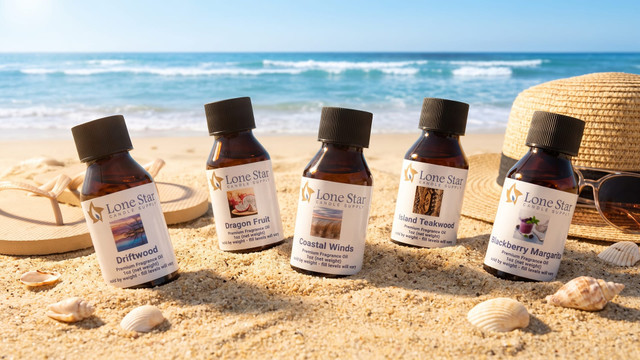
Weighing fragrance oil is what keeps a scent consistent from one batch to the next. A digital scale weighs the oil into your melted wax so every candle holds the same wax-to-fragrance ratio and scents the way you intend, where measuring by eye never will. This guide covers the full technique: how to pick a scale, how to tare your pouring pot, how to weigh the oil in, and how long to stir so the fragrance binds into the wax. For how much oil to use, see our Fragrance Oils FAQ; to work out the exact weight for a given batch, our Fragrance Oil Calculators do the math.
Choose a Scale
Any digital kitchen scale that reads in both ounces and grams will work. A few features make candle work easier and more accurate.
What to Look For in a Candle Making Scale
Tare (zero) Button
Lets you cancel out the weight of the pouring pot so the scale reads only the fragrance you add. This is the single most useful feature for candle work.
Resolution
A scale that reads to 0.1 oz or 1 gram is fine for most batches. Finer resolution helps when you measure small amounts of oil for a test candle.
Capacity
A full pouring pot of wax is heavy. Pick a scale rated well above the weight of your largest batch plus the pot.
Unit Switching
Ounces are common for candle recipes; grams give finer steps on small pours. A scale that toggles units lets you match whatever number a recipe lists.
Browse our digital scale, sized for candle making, and our pouring pots in seamless aluminum that sit flat on a scale.
How to Measure and Add Fragrance Oil
The wax is already weighed, melted, and sitting at about 180°F. Measure the fragrance by weight directly into the pot so the oil binds while the wax is warm.
How to Measure and Add Fragrance Oil to Wax
-
1
Protect the scale
Set a paper plate or a sheet of paper on the scale platform first. It shields the surface from a hot pouring pot and catches any drips.
-
2
Power on the scale
Turn the scale on. You will zero it in the next step once the pot is in place, so there is nothing else to set here.
-
3
Set the pot on the scale and tare to zero
Place your melted pouring pot on the scale, then press tare. The readout returns to zero so it will count only the fragrance you add next, not the weight of the wax and pot.
-
4
Pour the fragrance in slowly to your target weight
Take your bottle of fragrance oils and pour it in slowly, watching the readout climb. Stop when you reach the weight your recipe calls for. Pouring slowly near the end keeps you from overshooting, since you cannot take oil back out.
-
5
Stir two to three minutes to bind the fragrance
Stir with a metal spoon for about two to three minutes. Keep going until you no longer see fragrance oil pooling or swirling on the surface. That tells you the oil has bound into the wax. Some oils take longer than others, so stir as long as it takes.
See the technique in motion in the short tutorial below.
How Much Fragrance to Use
A common rule of thumb is one ounce of fragrance per pound of wax. It is a starting point, not a fixed number: each wax retains a different amount of oil, and any excess past that maximum separates from the wax instead of adding throw. You can load up to the wax's recommended maximum, but never past it.
To find out how much fragrance a given wax holds and how that scales to your candle size, see our Fragrance Oils FAQ. To work out the exact fragrance weight for a specific batch, use our Fragrance Oil Calculators. Once the load is dialed in, our scent guide covers the other levers that drive scent throw: pour temperature, wick size, and cure time.
Add Fragrance at the Right Temperature
Add the oil when the wax is around 180°F, then stir for a full two minutes. At that temperature the fragrance disperses and binds evenly into the wax. Much cooler and it will not blend in properly; much hotter and the lightest top notes degrade. For the full prep sequence that gets the wax to this point, see our How to Prepare Wax for Pouring guide.