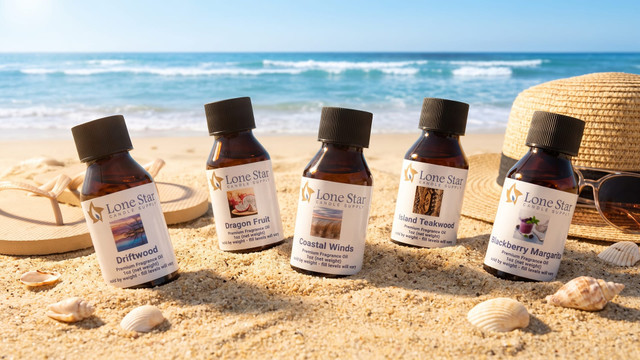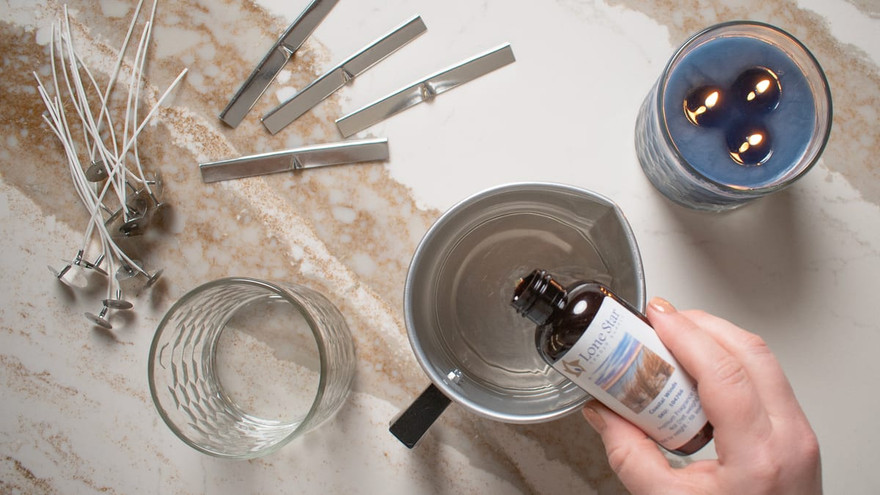
We have been answering fragrance oil questions from makers since 1999, and the same ones come up again and again. This page collects them. The first question, how much fragrance oil to use, deserves more than a one-line answer, so it gets its own section below with the maximum fragrance loads recommended for every wax we carry. The rest are in the FAQ list further down, from shelf life and bottle quirks to gel, soap, and labeling. Every spec discussed here is listed on the product page of each of our fragrance oils.
How Much Fragrance Oil to Use
Start at 1 ounce of fragrance oil per pound of wax, which is about 6% by weight. The industry baseline for a lightly scented candle is half an ounce per pound; most container waxes comfortably hold double that, and several hold more. You can load up to your wax's tested maximum, but never beyond it. Wax can retain only a certain amount of fragrance oil, and any excess may separate from the wax rather than contribute to scent throw.
The maximum varies more by wax than makers expect, from 3% in a base paraffin to 11% in an enhanced soy blend. These are the manufacturer-recommended maximum fragrance loads for the waxes we carry:
Maximum Fragrance Load by Wax
| Wax | Max load | Per pound of wax |
|---|---|---|
| Golden Brands 444 soy (container) | 9-11% | 1.44-1.76 oz |
| Golden Brands 415 soy (container) | 8-10% | 1.28-1.6 oz |
| IGI 4633 container paraffin (J-223) | 8-10% | 1.28-1.6 oz |
| Golden Brands 464 soy (container) | 7-9% | 1.12-1.44 oz |
| NatureWax C-3 soy (container) | 6-9% | 0.96-1.44 oz |
| Golden Brands 402 soy (container) | 6-8% | 0.96-1.28 oz |
| Golden Brands 454 coconut soy (container) | 5-10% | 0.8-1.6 oz |
| IGI 4627 / 4630 / 4636 / 4786 container paraffins | 6-10% | 0.96-1.6 oz |
| IGI 4625 pillar / 4761 and 4794 votive blends | 6% | ~1 oz |
| Golden Brands 494 melt and tart wax | 5-10% | 0.8-1.6 oz |
| IGI 4826 tart and chip wax | 6-8% | 0.96-1.28 oz |
| IGI 1230 / 2281 base paraffins | 3-4% | 0.48-0.64 oz |
Base paraffins can hold more fragrance with an additive such as Vybar 103 or Vybar 260. Each wax's product page carries its own load spec, our candle waxes & additives guide compares the waxes side by side, and our Fragrance Oil Calculators turn a percentage into ounces for any batch size. To see the process done step by step, watch Measuring & Adding Fragrance Oil to Your Wax.
For soap and other personal care products, fragrance usage depends on both the application and the formulation. The IFRA certificate on each fragrance's product page lists the maximum usage level considered safe for each product category[1], while the appropriate amount for a particular product depends on the type of base being used.
Double and Triple Scenting
These terms count up from the 0.5 oz per pound baseline: double scenting is 1 ounce of fragrance per pound of wax, and triple scenting is 1.5 ounces per pound. Triple scenting only works in a wax whose maximum allows it, so check the table above before pushing the load.
Weak Scent Throw
When a candle's scent will not fill a room, the cause is almost always one of four factors: fragrance load, the temperature at which the fragrance oil is added, wick size, or cure time. You can load up to the wax's maximum, add the oil at about 180°F and stir for two full minutes, size the wick so the melt pool reaches the jar's edge, and allow the candle to cure for about a week before its first burn. Our scent guide covers each of these factors in order, then explores fragrance notes, scent families, and blending your own scents.
What the Specs on a Product Page Mean
Every Lone Star fragrance oil page lists the data behind the oil. Here is what each spec tells you:
The Specs on Every Fragrance Oil Page
Flash Point
The temperature at which the oil can ignite if exposed to a spark or open flame[2]. It is safe to add fragrance to wax above its flash point; the safety rule is keeping the oil away from open flames.
Vanillin Content
Predicts how much the oil may darken a candle or soap over time. See our guide to vanillin content for how it works and how to plan around it.
Phthalate-Free Status
Indicates whether the fragrance oil contains DEP, the only phthalate still commonly used in the fragrance industry[3]. Our guide to phthalates and DEP explains what that means for makers who want to formulate and label their products as phthalate-free.
Gel Compatibility
Whether the oil is non-polar and suits candle gel. Most gel manufacturers also ask for a flash point of at least 170°F. Browse our Gel Safe Fragrance Oils for the full list.
Soap Safety and IFRA
The IFRA certificate lists the oil's maximum usage level for each application.
SDS
The Safety Data Sheet lists ingredients, handling information, fire and spill measures, and any California Prop 65 warnings[4].
If you cannot find the answer to your question here or in the FAQ below, our customer service team is happy to help.