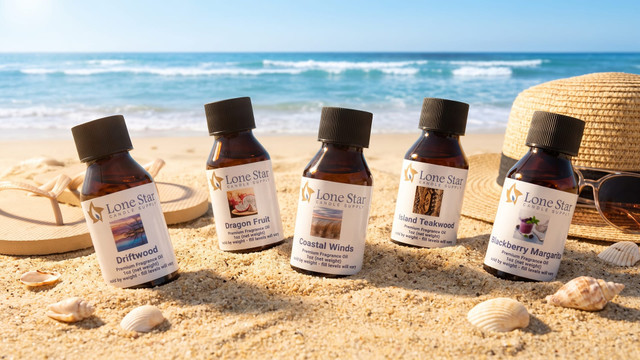
Essential oils and fragrance oils both scent a candle, and the two words get used as if they mean the same thing. They do not. An essential oil is pulled straight out of a plant, while a fragrance oil is a blend of aroma materials formulated for a purpose. That difference is why they behave differently in hot wax, and it is why candle suppliers, including Lone Star, stock fragrance oils for candle making. This guide covers what each oil is, how they compare when you actually burn the candle, and what to reach for depending on what you are making.
What Each Oil Is
The names describe two different things: where the scent comes from, and what it was made for.
Two Different Materials
Essential Oil
A concentrated extract taken from plant material by distillation or cold pressing. Its makeup is whatever chemistry the plant produced, so it carries the scent of that single botanical and nothing outside it. There is no regulatory definition of the term itself; how a product is regulated depends on how it is marketed and used[1].
Fragrance Oil
A blend of aroma materials, both synthetic and naturally derived, formulated to smell a certain way and to perform in a product. Because it is designed rather than extracted, a fragrance oil can hold a scent through heat, throw consistently, and reproduce smells no plant yields on its own, from clean cotton to a bakery.
How They Behave in a Burning Candle
The real question for a maker is not chemistry on paper, it is what happens once the wax is hot and the candle is lit. Essential oils and fragrance oils diverge on the things a candle is judged by.
Essential Oils vs. Fragrance Oils in Candles
| Factor | Essential Oil | Fragrance Oil |
|---|---|---|
| Scent throw at a safe load | Often softer; some components fade in heat | Formulated to fill a room at a normal load |
| Behavior in hot wax | Lighter top notes can degrade at wax temperatures | Built to survive pour and burn temperatures |
| Range of scents | Only what a plant produces | Any scent, including blends and clean/fresh notes |
| Batch-to-batch consistency | Varies with crop, harvest, and region | Formulated to smell the same every batch |
| Safety documentation | Varies by supplier | IFRA usage level per application on every oil[3] |
| Candle data provided | Rarely candle-specific | Flash point, vanillin, gel and soap flags per oil |
| Cost at candle loads | High, climbs with load | Priced for scenting at candle loads |
The heat point is the one makers underestimate. When an essential oil is held at high temperature, its lighter components can chemically break down: in one tested case, the main scent compound in a leaf essential oil dropped from roughly 93% to 28% of the oil after a spell at 150°C, converting into other compounds that smell different[2]. A candle does not reach that temperature, but the same class of change happens more slowly at the temperatures wax is poured and burned at, which is why an essential-oil candle can smell thinner than the bottle promised. A fragrance oil is formulated to hold its character through that heat.
Can You Use Essential Oils in Candles?
You can. Nothing stops you from adding an essential oil to melted wax the way you would a fragrance oil. Expect a softer, less consistent result at a higher price: some of the scent degrades in the heat, throw tends to be weaker at a safe load, and essential oils cost considerably more per ounce than fragrance oils formulated for candles.
Why Lone Star Carries Fragrance Oils
When a maker searches our store for essential oils, we point them to fragrance oils on purpose. Fragrance oils are the material a candle business can be built on.
What Fragrance Oils Give You
They Hold Up in Heat
A fragrance oil is formulated to keep its scent through the pour and the burn, so the candle smells the way it did in the bottle.
They Throw Consistently
The same oil smells the same batch after batch, which matters the moment you sell candles instead of making one for yourself.
They Come With Candle Data
Every Lone Star fragrance oil's product page lists its flash point, vanillin content, and gel and soap compatibility, along with top, middle, and base notes, so you can match an oil to what you are making.
They Carry Safety Documentation
Each oil has an IFRA usage maximum per application, so you know the level it is approved for.
They Cover Scents Nature Cannot
Clean cotton, birthday cake, ocean air, and countless designer-inspired blends exist only as fragrance oils.
We carry over 275 fragrance oils, and the whole range is browsable by scent family with those specs on each page. A top selling sample pack is the low-risk way to test throw across several oils before you commit to a full size.
If You Want a Natural-Leaning Candle
The pull toward essential oils is often a pull toward a cleaner, more natural candle. You can get most of the way there without giving up throw. Pour a plant-based wax such as soy wax guide, choose a phthalate-free fragrance oils so you can label accordingly, and be straightforward on the label about what the candle is scented with. Many makers prefer to avoid phthalates, and our phthalate-free oils let you make that choice while keeping the performance a fragrance oil gives you. To build a signature scent from those oils, our scent guide walks through notes, families, and blending.
Wax Melts, Soap, and Other Products
The same trade-off carries beyond candles. A wax melt sits on a warmer and depends on scent surviving low, steady heat over hours, which is exactly where a fragrance oil's stability pays off and an essential oil tends to fade. For soap and products applied to the skin, the deciding factor is the application: choose an oil approved for that use and stay within its IFRA usage level, which our soap-safe fragrance oils are marked for. However much fragrance you use, how much a candle can hold comes from the wax, not the oil; our Fragrance Oils FAQ covers loads by wax type.