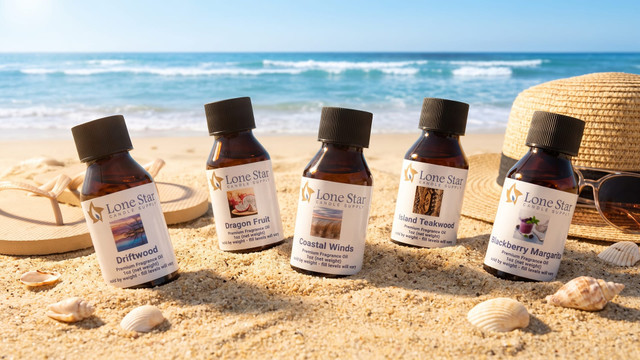
Roll-on perfume comes down to two ingredients: a skin-safe fragrance oil and a light carrier oil, rolled onto your skin from a small bottle. It is one of the quickest projects in the catalog and a friendly one to make with kids, since there is no heat and no melting involved. The whole recipe is measuring two oils by weight into a roller bottle and capping it.
The one rule that matters is the fragrance has to be skin-safe, because the blend goes directly onto your skin rather than into a candle. We carry over 275 fragrance oils, and every product page lists the skin and lotion compatibility plus the IFRA usage levels you need to scent something you wear. This guide covers what to gather, the ratio we use, why weight beats volume, and how to apply and store the finished perfume.
What You Need
The supply list is short, and you likely have most of it already. The only two items you have to buy with care are the fragrance oil, which must be skin-safe, and a carrier oil light enough to wear.
Roll-On Perfume Supplies
Roller Bottle
A small glass bottle with a roller-ball top. We do not carry roller bottles, so you will need to buy one separately. Amber or cobalt glass protects the blend from light, and the pipette and funnel that ship with many bottle sets make filling easier.
Skin-Safe Fragrance Oil
The scent. It must be compatible with skin-contact products, so look in the category for lotions, body creams, and oils to confirm an oil is safe for this use and find its maximum usage level. Browse the range in our fragrance oils collection.
Carrier Oil
A light, low-odor oil that dilutes the fragrance and carries it onto your skin. Fractionated coconut oil stays liquid, has almost no scent of its own, and absorbs quickly.
Small Scale
A scale that reads in grams to two decimal places. At this volume, grams are far easier to measure accurately than ounces.
Funnel or Pipette
A small metal funnel or a pipette keeps the carrier oil and fragrance from running down the side of the bottle.
Measure by Weight, Not Volume
Fragrance oils do not all weigh the same for a given volume. A light fragrance takes up more space than a dense one at the same weight, so two oils measured by the teaspoon can deliver very different amounts of actual fragrance. Set side by side in a measuring cup, a low-density scent like a fruit blend looks like more liquid than a heavier scent at the same weight.
Measuring in grams removes that guesswork. A scale reads the true amount regardless of density, so your recipe is repeatable: the same numbers give the same perfume every time, and you can scale a blend you like up to a larger batch. This is also why we sell fragrance oils by weight rather than volume.
How to Make Roll-On Perfume
Most of a roll-on perfume is carrier oil, with a smaller amount of fragrance blended in. How much fragrance you can use depends on the scent, so keep it at or below the maximum usage level the product page lists for skin-contact products. Start light, then adjust the ratio to your preference once you have made one.
Fill and Seal a Roller Bottle
-
1
Zero the scale with the bottle and funnel
Place the empty roller bottle on the scale, set the funnel into its neck, then turn the scale on so the display reads zero. This sets the bottle and funnel weight aside so you only measure what you add.
-
2
Add the carrier oil
Pour fractionated coconut oil through the funnel until the bottle is most of the way full, leaving room for the fragrance and the roller ball. A steady hand can pour straight through the funnel; if that is awkward, measure the carrier into a small cup first, then transfer it in.
-
3
Tare, then add the fragrance
Zero the scale again with the carrier oil in the bottle. Using a pipette, add the skin-safe fragrance oil, staying within the maximum usage level its product page lists. Add it slowly, since a light fragrance can jump past your target with one heavy pour.
-
4
Leave headroom for the ball
Lift off the funnel and check the fill level. Leave a little space at the top so the roller ball can seat and so you can swirl the blend.
-
5
Seat the ball and cap it
Press the roller ball firmly into the neck until it clicks home, then screw on the lid. Swirl the bottle gently to combine the two oils. The perfume is ready to use.
Use a Skin-Safe Fragrance Oil
Because roll-on perfume sits on your skin all day, the fragrance has to be rated for skin contact. Fragrance products worn on the body are regulated as cosmetics, and the maker is responsible for making sure the blend is safe at the level it is used[2]. Every Lone Star fragrance oil compatible with lotions and body products lists its maximum usage level on the product page; the IFRA maximum usage level is the ceiling for products you apply to your skin, and real-world use also depends on the carrier you blend it into[1].
Fragrance oils are more concentrated than perfumes. The same skin-compatible oils work in lotion bars, body oils, and bath products, so a scent you blend here can carry across a small line. For room and fabric scents that are not worn on skin, see our guide to How to Make Room Sprays, Linen Sprays, & Body Mists.
How to Apply and Store It
Roll the perfume onto pulse points, where blood runs close to the surface and gives off a little warmth that helps the scent lift. Store the bottle so the blend keeps its character.
Wearing and Keeping Roll-On Perfume
Pulse Points
Apply to the wrists, the sides of the neck, behind the ears, and the inner elbows. Roll a thin layer; you can always add more. Let it absorb rather than rubbing your wrists together, which can bruise the lighter top notes.
Reapply as Needed
An oil-based perfume sits close to the skin and lasts a few hours. Carry the bottle and re-roll through the day rather than over-applying at once.
Store Cool and Dark
Keep the bottle capped, away from heat and direct sunlight. Amber or cobalt glass slows light exposure and helps the scent hold.
Make Small Batches
Mix what you will use over a few months. If the scent or color shifts, blend a fresh bottle from the same recipe.
For more ways to put a scent to work, browse our fragrance recipes and the rest of the Learning Center.