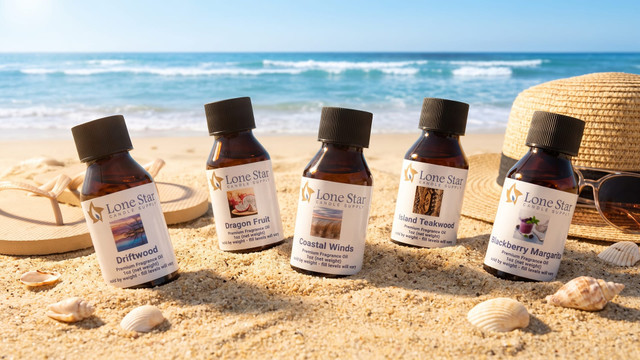
Spring is when makers reach for florals, fresh laundry, green stems, and bright citrus. The recipes below are tested starting points built from our own fragrance oils. Every blend links straight to the oils so you can match the recipe, and the method that follows shows how to mix and test a spring scent of your own. For other seasons and themes, start with our full collection of fragrance recipes.
These are fragrance oil recipes, not essential oil recipes. Fragrance oils are formulated to hold up to the heat of melted wax, where most essential oils fade or degrade. Each oil below lists its notes, flash point, and recommended load on its product page.
Tested Spring Blend Recipes
Each recipe gives the oils and a starting ratio. Ratios are by weight, and the total fragrance stays within your wax's recommended load. Treat them as a starting point: pour a single test candle, judge it by its hot throw after a cure, and adjust the ratio before you scale a recipe up.
Six Spring Blends to Pour
Texas Wildflowers
1 part Bluebonnet, 1 part French Market
Spring Fling
1 part Sunwashed Linen (type), 1 part Twilight Woods (type)
Vanilla Lilac Macaron
1 part Lilac, 2 parts Vanilla Bean
Country Clothesline
1 part Vanilla Cotton, 1 part Sunwashed Linen (type)
Pink Blossom
1 part Japanese Cherry Blossom (type), 1 part Pink Chiffon (type)
The Yellow Rose of Texas
1 part Rose Petals, 2 parts Amber Romance
How to Blend and Test a Spring Scent
Building your own seasonal blend is one of the most satisfying ways to get creative with fragrance. Work in small trials first so you can refine the blend before committing it to a batch of wax.
Mix and Test a Custom Spring Blend
-
1
Pick a dominant note and a supporting note
Choose a dominant spring note, such as a floral, fresh laundry, or bright citrus, then pick one or two oils to support it. Green and citrus notes can add freshness and contrast to softer floral fragrances.
-
2
Set a starting ratio
Begin with about 2 parts of the dominant oil to 1 part of each supporting oil. Stronger notes, such as some floral and fresh-laundry fragrances, can often be used more sparingly without losing their presence in the blend.
-
3
Trial on Q-tips
Dip a separate Q-tip in each oil at your ratio and seal them together in a small jar. Let them sit at least an hour, then open and smell. To push one scent forward, add another Q-tip of it and re-test. Write down the ratio every time so you can reproduce it.
-
4
Pour a test candle
Once a Q-tip blend smells right, measure the oils by weight, add them to wax at about 180°F, stir two full minutes, and pour one test candle. Cure it about a week, then burn it and judge the blend by its hot throw, adjusting the ratio before you scale up.
For more on balancing the three note levels and choosing a scent family, see our scent guide.
Spring Scent Families
Most spring fragrances fall into a handful of groups. Knowing which group an oil sits in makes it far easier to pair two oils that complement each other instead of clashing. Use this as a reference when you build your own blend.
The Spring Scent Families
| Family | Character | Typical notes | Role in a blend |
|---|---|---|---|
| Florals | Soft, romantic, classic | Lilac, honeysuckle, jasmine, peony | Heart note; the signature of spring |
| Fresh & Clean | Airy, laundered, light | Clean cotton, spring rain, linen | Top note that opens a blend |
| Green & Herbal | Crisp, leafy, grounding | Cucumber, eucalyptus, sage, basil | Base or heart that keeps a floral from going sweet |
| Citrus & Fruit | Bright, zesty, cheerful | Lemon, bergamot, verbena, melon | Top note that lifts and brightens |
A good spring candle usually draws from two of these: a soft floral or fresh top to open, and a green or citrus note to keep it bright. Browse the full range of fragrance oils by category, each with its flash point, recommended load, and gel and skincare compatibility.
Loading and Curing Spring Candles
Light florals and fresh notes often benefit from a proper fragrance load and cure time, as their more delicate characteristics become more noticeable as the candle cures.
Each oil's IFRA Certificate lists its maximum usage level for each application, and real-world usage also depends on the wax or base it goes into. The product page also lists the flash point, the temperature at which an oil can ignite if exposed to a spark or open flame. It is safe to add a fragrance to melted wax above its flash point; keep the oil itself a safe distance from any open flame.
More Seasonal Recipes
Spring is one stop in a full year of seasonal and themed blends. For summer, fall, and winter recipes, plus floral, citrus, and other themed sets, browse our full collection of fragrance recipes.