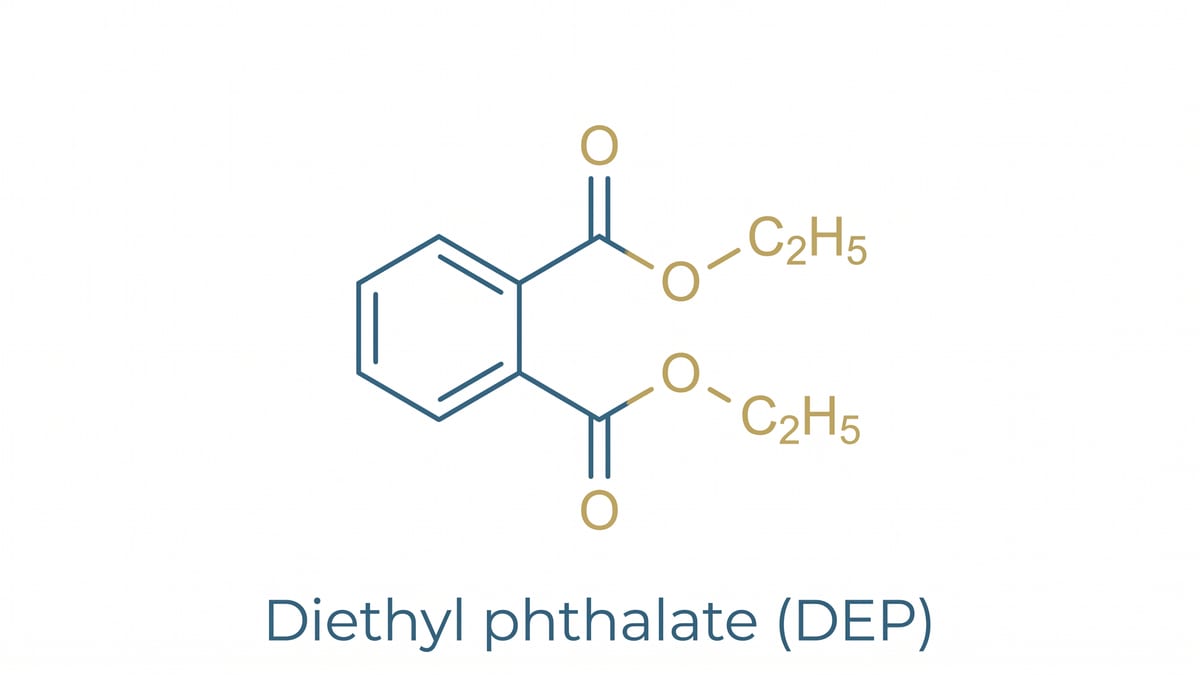
Phthalates have received a lot of attention over the years, yet there is still considerable confusion about what they are and how they're used. The term covers a wide variety of compounds of differing chemical structure[1]; no one would call all berries or all mushrooms unsafe because some species are toxic, and phthalates differ from one another in the same way. The safety concerns you have read about center on dibutyl phthalate (DBP) and diethyl hexyl phthalate (DEHP). None of our fragrance oils contains either. The oils we carry that are not labeled phthalate-free contain exactly one phthalate, diethyl phthalate (DEP), and more than 200 of our fragrance oils contain no phthalates at all. Every product page states which group an oil belongs to.
What Phthalates Do in Fragrance
In a fragrance oil, DEP is a workhorse solvent and fixative[2]. It dissolves fragrance components into wax and other bases, helps disparate ingredients blend evenly, and acts as a fixative that makes a scent last longer. It is particularly useful in candle fragrances because it solubilizes the fragrance into the wax and prevents crystallization in certain oils. Outside the fragrance industry, DEP is also the denaturant in SDA Alcohol 39-C, the denatured alcohol formula endorsed by the US government.
The Restricted Phthalates
Seven phthalates are classified as CMRs (carcinogenic, mutagenic, or reproductive toxicants), and the European Union barred them from cosmetics and skin care products in 2004[3]. These seven are the source of the family's bad reputation.
The Seven CMR-Class Phthalates
| Phthalate | CAS number | Regulatory status |
|---|---|---|
| DEHP (di-2-ethylhexyl phthalate) | 117-81-7 | California Prop 65 list, 1988; EU cosmetics ban, 2004 |
| DBP (dibutyl phthalate) | 84-74-2 | Prop 65 list, 2005; EU cosmetics ban, 2004 |
| BBP (benzyl butyl phthalate) | 85-68-7 | Prop 65 list, 2005; EU cosmetics ban, 2004 |
| DnHP (di-n-hexyl phthalate) | 84-75-3 | Prop 65 list, 2005; EU cosmetics ban, 2004 |
| DIDP (diisodecyl phthalate) | 26761-40-0 | Prop 65 list, 2007; EU cosmetics ban, 2004 |
| DINP (diisononyl phthalate) | 28553-12-0 | CMR classification; EU cosmetics ban, 2004 |
| DnOP (di-n-octyl phthalate) | 117-84-0 | CMR classification; EU cosmetics ban, 2004 |
Where DEP Stands
The one phthalate that is used in fragrance, DEP (CAS 84-66-2)[5], has been reviewed repeatedly by the bodies that regulate fragrance and cosmetics:
- The International Fragrance Association (IFRA) publishes a position on DEP stating that consumers can use fragranced products containing it with confidence.
- The European Union's SCCNFP scientific committee published a safety review of DEP on June 4, 2002, concluding that it showed low levels of toxicity and that its safety profile supports its use in cosmetic products, with no specific warnings or restrictions recommended. The committee re-asserted that opinion in 2003, and its successor, the SCCP, did so again in 2007[3].
- The FDA, the US EPA, and the Research Institute for Fragrance Materials (RIFM) publish no restrictions or warnings on DEP in fragrance.
The testing behind those opinions found DEP to be neither a CMR nor a skin sensitizer or irritant[4]. That record is why DEP is sometimes called the "good phthalate" in the trade, and why it remains in wide use as a fragrance solvent, blender, and fixative.
Phthalate-Free Labeling
Many makers and their customers prefer to avoid phthalates altogether, and a phthalate-free label has become a selling point in candles, soap, and skincare. That preference is easy to serve: more than 200 of our fragrance oils contain no phthalates of any kind, giving you a broad selection of scents to choose from. Browse our phthalate-free fragrance oils, or check the status line on any product page.