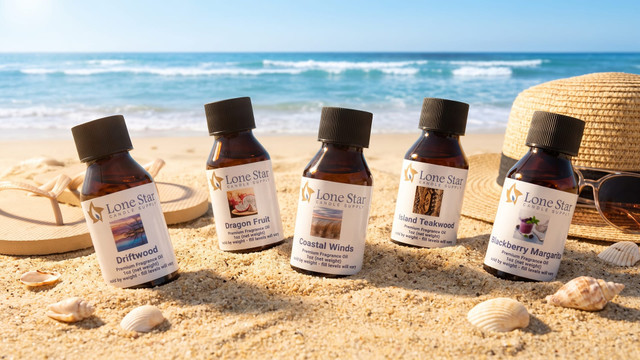
Every fragrance oil we sell lists an IFRA maximum usage level for each application on its product page, and the number is not the same across the board. The same oil can show one percentage for candles and a much lower one for a lip balm. Makers often read that as a quality score or a recipe, and it is neither. An IFRA maximum usage level is a safety ceiling: the most of that oil, by weight, that is considered safe in a finished product for a specific use[1]. How much fragrance a candle actually needs is a separate question answered by the wax, not the oil, and our Fragrance Oils FAQ covers that side.
This guide explains what the number means, why it changes from a candle to a bar of soap to a lip balm, how those limits get set, and how to read them off the IFRA certificate on any product page.
What IFRA Is
IFRA is the International Fragrance Association. It publishes the IFRA Standards, which the association describes as a globally recognized risk-management system for the safe use of fragrance ingredients[1]. The Standards look at individual fragrance materials, review the science on each one, and set limits on how much can appear in a finished product. Fragrance suppliers then issue an IFRA certificate for every oil, translating those ingredient limits into a maximum usage level for each type of product the oil might go into.
When a query asks what IFRA means or what an IFRA-compliant fragrance oil is, this is the short answer: the oil has been assessed against those Standards, and its certificate states the safe maximum for each application.
What a Maximum Usage Level Means
A maximum usage level is a percentage of the finished product. Weighing your ingredients is the standard way to hit it, but the percentage holds no matter what measuring unit you work in. If an oil lists 15% for soap, a compliant bar keeps that oil at or below 15% of the finished soap. The figure is a ceiling for safety, so you can load up to it but never past it. Most of our oils carry a 100% maximum for candles, since a candle never touches skin, so the limit that actually constrains a recipe usually shows up on the skin-contact applications like soap and lotion.
Two things are worth keeping straight. First, the limit is per application, not a single number for the oil. An oil carries separate maximums for candles, soap, lotion, and lip products, and they can differ widely. Second, the real-world amount you use also depends on the base or formulation the oil goes into, not the IFRA figure alone. The certificate gives you the outer safety limit for an application; your wax, soap base, or lotion base sets what works within it.
For candles specifically, the IFRA maximum is almost never the amount you should pour. Candle fragrance load comes from the wax's manufacturer-recommended maximum. Read the IFRA number as the safety limit and let the wax decide the dose. Our Fragrance Oil Calculators turn a chosen percentage into an exact weight once you know the load you are aiming for.
Why the Limit Changes by Application
The limits track exposure. The more a product touches skin, and the longer it stays there, the stricter the safe percentage. A candle scents the air and never contacts skin, so its application usually carries the highest limit or no restriction. A lip product sits on the mouth and can be ingested, the highest-exposure case, so it carries the lowest limit. Rinse-off soap and leave-on lotion fall in between.
How Skin Contact Shapes the Limit
| Application | Skin contact | Typical limit |
|---|---|---|
| Candles | None; scents the air only | Highest, often unrestricted |
| Reed diffusers, air fresheners | None; airborne | High |
| Soap (rinse-off) | Brief, then washed away | Moderate |
| Lotion, body products (leave-on) | Prolonged, stays on skin | Lower |
| Lip products | Constant, can be ingested | Lowest |
The exact percentage for any one oil still comes from its own certificate, since the ceiling depends on the specific fragrance ingredients inside it. The pattern above is why a single oil can read as safe at a high load in a candle and need a much smaller fraction in a product applied to the skin.
How the Limits Are Set
IFRA does not pick these numbers by feel. They come from a method called Quantitative Risk Assessment, or QRA, which the fragrance industry adopted to prevent skin sensitization from fragrance materials[2]. In plain terms, the assessment estimates how much of an ingredient a person is exposed to from a given product type, compares that against the level at which the ingredient could provoke a reaction, and sets the safe concentration from the gap between them.
Because exposure differs by product, the same ingredient produces different safe levels for different uses. When IFRA first published Standards under this method, the limits were set across eleven separate product categories[2], which is where the per-application structure on every certificate comes from. Categories built around leave-on skin contact land at stricter limits than categories for products that never touch skin.
Finding the Certificate on a Product Page
Every fragrance oil's product page carries its IFRA certificate under the Technical Information tab, next to the Safety Data Sheet[4]. Reading it takes a few steps.
How to Read an IFRA Certificate
-
1
Open the product page
Go to the fragrance oil you are working with and find the Technical Information tab, which lists its IFRA certificate and Safety Data Sheet.
-
2
Open the IFRA certificate
The certificate is the document that lists maximum usage levels. The Safety Data Sheet next to it covers handling, fire, and spill information, not usage percentages.
-
3
Find your application
Locate the row for what you are making: a candle, soap, a leave-on lotion, or a lip product. Each application has its own maximum.
-
4
Read the maximum percentage
The number is the highest concentration of that oil, by weight, allowed in the finished product for that application.
-
5
Stay at or below it, and mind the base
Keep your fragrance at or under that percentage. Remember the number is a ceiling: your wax or base sets the amount that performs well within it.
For candles, once you have the ceiling, size the actual pour from the wax's recommended load rather than the certificate. For products applied to the skin, the certificate is the figure you build the recipe around.
IFRA and the Law
Candles are not cosmetics, and no federal law requires a candle to meet an IFRA limit. IFRA compliance is the fragrance industry's voluntary safety benchmark, and reputable suppliers follow it and publish the certificate so makers can too.
Products applied to the skin are a different matter. Soap, lotion, and lip products are cosmetics, and under the law the person who makes or markets a cosmetic is responsible for making sure it is safe[3]. The IFRA certificate is the tool that lets you show your fragrance stays within a safe level for that use.
Where to Go From Here
Once you can read the certificate, the rest is putting the number to work. Our Fragrance Oil Calculators convert a target percentage into an exact weight for your batch. For how much fragrance a candle actually needs, which is a wax question rather than an IFRA one, see the Fragrance Oils FAQ. If your question is specifically about phthalates and DEP on the Safety Data Sheet, the phthalates and DEP guide covers that. And you can browse our full range of fragrance oils, each with its IFRA certificate, flash point, and fragrance notes on the product page.